
St. Mary's Church
SAINT MARY'S CHURCH
FOUNDING
A Chapel was built in Luddenden in about 1496 (according to John Watson’s book ‘The History and Antiquities of The Parish of Halifax’ published in 1775). This chapel was paid for by the local residents and fell within the Parish of Halifax.
A Licence for the celebration of Masses and other divine Offices was granted by Thomas Rotherham, Archbishop of York in 1496.
‘..the inhabitants and residents, due to the weakness of old age, being detained by various illnesses, and especially because pregnant women and many others find the distance too exhausting, they are unable to attend the celebration of masses and the canonical hours in the said parish church of Halifax on Sundays and other feast days.
And furthermore, when they frequently wish to go to their parish church of Halifax on feast days, or due to a wedding, they are often completely unable to enter because of heavy rains or other storms and tempests in the valley of Luddenden, or due to the growing crowd of people and parishioners on those days.’
So bad weather, a full church in Halifax, ill health, old age and pregnancy were all cited as reasons that impeded worship by the citizens of Luddenden.
The licence encourages people who were healthy enough to make the journey from Luddenden to worship at Halifax on important days;
* The Nativity of Our Lord Jesus Christ (Christmas)
* The Epiphany
* The Purification of the Blessed Virgin Mary (Candlemas)
* Easter
* Pentecost
* The Nativity of Saint John the Baptist
* The Assumption of the Blessed Virgin Mary
* The Dedication Feast of their said parish church
* All Saint
St Mary’s were responsible for hiring the priest and to pay his salary. The Priest was required to visit Halifax Parish church within 15 days of his appointment to swear an oath, he must:
‘approach the parish church of Halifax and publicly, in the presence of the Vicar there (or in his absence, before his Curate, touching the Holy Gospels of God), take a bodily oath that he will bring no prejudice, loss, or damage whatsoever to the parish church of Halifax, its proprietors, or its Vicar, or those acting in their place, regarding tithes, oblations, mortuary fees, annual portions, pennies for requested items, or mortuary legacies, or any other rights by whatever name they may be called.’
And St Mary’s were still obliged to pay tithes, mortuary fees and oblations to the mother parish of Halifax. If they failed to comply with any of the terms in the Licence, then this would be revoked.
PAROCHIAL RIGHTS part one
St Mary's, a church within the Parish of Halifax, by special licence could hold services at the church as long as they paid their dues to the Mother Parish. But the villagers' wanted more authority in their own church.
In 1535 they petitioned Henry VIII asking for Parochial rights. This was approved and passed to Archbishop Cranmer to action.
This was an interesting time for the Church in the UK. The recent appointment of the protestant Cranmer as Archbishop of Canterbury had been approved by Pope Clement VII but only as an act of appeasement. The Pope was trying to stop the growing rift between England and Rome. Henry’s marriage to Catherine of Aragon was annulled by Cranmer in 1533 much to the anger of the Pope. This put an end to any hope of reconciliation.
So Luddenden asking for parochial rights at this time could be seen as a clear message of support for the King and his movement away from papal control.
Cranmer in turn asked Edward Lee, Bishop of York to action the Bill to give Luddenden Church Parochial rights, but Lee seems to have been in two minds, whether to support the Pope or to support the King. He spent many years fighting with his conscience trying to decide on the best course of action.
He died in 1544 with the issue of Luddenden’s parochial rights still on his to do list. The process of approving Parochial Rights had stalled.
PAROCHIAL RIGHTS part two
A Church has existed on the site since the mid C16, and the present building was erected in 1816.
The original 16th century font and a churchyard cross were broken by parliamentary forces during the Civil War, but were discovered in a nearby garden (which had belonged to one of the churchwardens at the time they were broken) at the beginning of the 20th century
The font is now in the church, and the octagonal stone post in the churchyard. The font now in use replaced the previous one in 1662.
A chest tomb in the churchyard bears the relics of Thomas Murgatroyd of Murgatroyd and East Riddlesden Hall, Keighley, who died in the mid 17th century.
There is also a listed bridge made of Ashlar Stone, constructed in 1859, leading into the municipal cemetery.
-
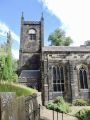 The bell tower
 -
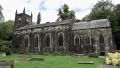 Southern elevation of the church
 -
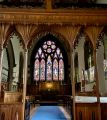 The altar
 -
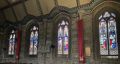 Stained glass windows


