
St. Mary's Church
SAINT MARY'S CHURCH
FOUNDING
A Chapel was built in Luddenden in about 1496 (according to John Watson’s book ‘The History and Antiquities of The Parish of Halifax’ published in 1775) and a Licence for the celebration of Masses and other divine Offices was granted by Thomas Rotherham, Archbishop of York.
The chapel which was paid for by the local residents fell within the Parish of Halifax.
‘..the inhabitants and residents, due to the weakness of old age, being detained by various illnesses, and especially because pregnant women and many others find the distance too exhausting, they are unable to attend the celebration of masses and the canonical hours in the said parish church of Halifax on Sundays and other feast days.
And furthermore, when they frequently wish to go to their parish church of Halifax on feast days, or due to a wedding, they are often completely unable to enter because of heavy rains or other storms and tempests in the valley of Luddenden, or due to the growing crowd of people and parishioners on those days.’
So bad weather, a full church in Halifax, ill health, old age and pregnancy were all cited as reasons that impeded worship by the citizens of Luddenden.
The licence encourages people who were healthy enough to make the journey from Luddenden to worship at Halifax on important days;
* The Nativity of Our Lord Jesus Christ (Christmas)
* The Epiphany
* The Purification of the Blessed Virgin Mary (Candlemas)
* Easter
* Pentecost
* The Nativity of Saint John the Baptist
* The Assumption of the Blessed Virgin Mary
* The Dedication Feast of their said parish church
* All Saint
St Mary’s were responsible for hiring the priest and to pay his salary. The Priest was required to visit Halifax Parish church within 15 days of his appointment to swear an oath, he must:
‘approach the parish church of Halifax and publicly, in the presence of the Vicar there (or in his absence, before his Curate, touching the Holy Gospels of God), take a bodily oath that he will bring no prejudice, loss, or damage whatsoever to the parish church of Halifax, its proprietors, or its Vicar, or those acting in their place, regarding tithes, oblations, mortuary fees, annual portions, pennies for requested items, or mortuary legacies, or any other rights by whatever name they may be called.’
And St Mary’s were still obliged to pay tithes, mortuary fees and oblations to the mother parish of Halifax. If they failed to comply with any of the terms in the Licence, then this would be revoked.
PAROCHIAL RIGHTS part one
St Mary's, a church within the Parish of Halifax, by special licence could hold services at the church as long as they paid their dues to the Mother Parish. But the villagers' wanted more authority in their own church.
In 1535 they petitioned Henry VIII asking for Parochial rights. This was approved and passed to Archbishop Cranmer to action.
This was an interesting time for the Church in the UK. The recent appointment of the protestant Cranmer as Archbishop of Canterbury had been approved by Pope Clement VII but only as an act of appeasement. The Pope was trying to stop the growing rift between England and Rome. Henry’s marriage to Catherine of Aragon was annulled by Cranmer in 1533 much to the anger of the Pope. This put an end to any hope of reconciliation.
So Luddenden asking for parochial rights at this time could be seen as a clear message of support for the King and his movement away from papal control.
Cranmer in turn asked Edward Lee, Bishop of York to action the Bill to give Luddenden Church Parochial rights, but Lee seems to have been in two minds, whether to support the Pope or to support the King. He spent many years fighting with his conscience trying to decide on the best course of action.
He died in 1544 with the issue of Luddenden’s parochial rights still on his to do list. The process of approving Parochial Rights had stalled.
PAROCHIAL RIGHTS part two
100 years later in 1624, a second attempt was made to get Parochial Rights, this time from James I.
In Rev. John Watson’s book, it states:
….’ by reason of foul weather, floods and craggy ways, the feeble old men, and women with child are hindered to come to devine service and sacrament (in Halifax) to their great discouragement and that also oftentimes some, especially of the poorer sort, in those remote places so far from the parish church (Halifax), lie most lamentably three or four days unburied…
  The Petitioners therefore do most humbly beseech (in regard there is already a fair chapel, ancient Churchyard, font and books and other necessaries with ornaments fit for a parochial church and that they will maintain both services and preaching upon their own costs)….’
The response from the King…
‘At the court of Greenwich, on 21st May 1624, his Majesty, well approving the religious intention of these Petitioners is graciously pleased to grant their request, and requireth his advocate General to make ready for his signature a warrant to the Archbishop of York ….(according to the precedent of King Henry VIII)….’
Consecration took place on 4th August 1624 and was witnessed by six of the area’s gentry:
- James Murgatroyd, he was one of the first people to be buried in the churchyard when he died in 1653, his table tomb survives
- William Midgley from one of the titled families in the area.
- Thomas Lacy. The Lacy family lived at Brearley Hall and also carried a title. Thomas held the lease to the Corn Mill at this time which had been given to him by the Murgatroyd’s. The families had ties through marriage. It was this lease was in turn, given as a dowry to the Murgatroyd family in 1632 when Jane Lacy married Henry Murgatroyd. The couple did extensive work to the mill in 1633 and their initials (H & I) are on the stone lintel from the mill which is now situated above the millstone at the bottom of Halifax Lane
- Gregory Patchett. He built the house we know as the Lord Nelson Pub, his initials also, are on the stone Lintel above the front door. He died in 1654;
- Jasper Lacy, another of the Lacy family and:
- Gilbert Deane who built Upper Saltonstall farmhouse in 1637, his initials are engraved in the stone lintel.
The size of the chapel in 1624 is also recorded. Its internal dimensions were 28 yards in length and 8 yards and one foot wide, circumference of the church yard was 240 yards, being 63 yards east to west and 58 yards north to south, so the Church building was a similar length but half the width of the current church.
STONE CROSS AND FONT
At the time of the consecration, a stone cross was installed in the churchyard. This was removed a few years later during the English Civil War and was thought to have been lost. It was rediscovered in the garden at Ellen Royd 100 years ago and moved back into the churchyard. Only the shaft of the cross has survived. This is a Grade Two listed monument.
The font was removed at the same time. One side was broken off it when it was moved from the church (as is still the law, to make sure that the font cannot be used for evil) so this now resembles a bucket seat and was known as Boggart’s chair. This too was found at Ellen Royd (a former name for Ellen Royd was Boggart House). It is now housed in St MAry's.
A replacement font was installed in 1662.
WHY WAS THERE SUCH A DELAY BETWEEN THE TWO PETITIONS?
This was not a good time time to pin your religious beliefs to your chest.
St Mary's would be operating as a Catholic Church, but the religious landscape was shifting.
The Second petition would have meant St Mary's would have to become a Protestant Church and this would cause division in the local area. Both Yorkshire and Lancashire were Catholic strongholds.
Religious unrest spilled over into the village in what can only be described as Sectarian Violence.
In 1536, Gilbert Brooksbank of Bank House, Warley who was the priest at St Mary’s (according to one source and St Thomas’ at Heptonstall to another source), was murdered by Robert Briggs, part of a feud between Sir Richard Tempest (Supporter of Henry VIII) of Bolling Hall, Bradford and Sir Harry Savile (Catholic) of Thornhill, Tankersley and Elland.
Sir Richard was well known to both Henry VII and Henry VIII. The latter had given him his knighthood during Sir Richard’s time fighting alongside Henry VIII in France. Sir Richard had held the post of High Sheriff of Yorkshire and was also a Justice of the Peace and in 1529 he became the Member of Parliament for Appleby.
But Sir Richard was a loose cannon. Allegations of corruption and murder surrounded him.
Priest Robert Holdsworth of Halifax who was a supporter of Sir Harry Savile and therefore not liked by Sir Richard Tempest was drawn into this conflict. He had been publicly critical of Henry VIII…..
“If Harry reigns long, he will take from us of the church all that we have. I pray God send him a short reign”
His words were reported back to the Monarch!! He became a target for Tempest's henchmen.
In 1536, Holdsworth was attacked and beaten at his Halifax vicarage. The vicarage was robbed and vandalised a further 4 times over the following years.
This culminated in an attack in 1556 when Holdsworth was murdered.
Turbulent times in England. The Pilgrimage of Grace
Looking at the wider perspective, 1536 was the year that Anne Boleyn was executed. Many people were unhappy with the direction that Henry VIII was taking the Church.
Riots started in Louth, Lincolnshire on Oct 1st 1536 but quickly spread into Yorkshire and Lancashire where Catholicism was still strong.
This uprising became known as The Pilgrimage of Grace.
Surprisingly, Sir Richard Tempest was an active member of this rebellion, breaking his allegiance to the King.
He was captured by The King’s Men and jailed at Fleet Prison in London, but he died of the Plague before he could be put on trial.
His younger brother Thomas who was also active in the rebellion was one of many that were hanged, drawn and quartered at Tyburn in 1537 for their treason.
Abbots and Monks from the local monasteries of Sawley and Whalley in Lancashire were amongst those put to death.
-
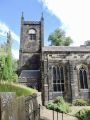 The bell tower
 -
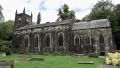 Southern elevation of the church
 -
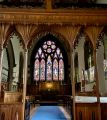 The altar
 -
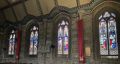 Stained glass windows


